
Holocaust Exceptionalism
The "uniqueness" of the Holocaust as an unexplainable evil is a Western concept that obscures its place in a long history of colonial genocide and fuels a lucrative industry to push Zionism.

NOTE: This is an excerpt from a longer article:

Holocaust exceptionalism is a cornerstone of Zionism. The overemphasis on the Holocaust, specifically the extermination of six million Jews, as some uniquely unprecedented event in human history is largely a Western, first-world phenomenon that reflects an extremely Eurocentric and Jewish-exceptionalist worldview.
False uniqueness of the Holocaust and antisemitism
Outside of the colonial-imperialist first world, the global majority today does not place the Holocaust and antisemitism on special pedestals. The global majority has itself experienced countless holocausts at the hands of the first world powers. A cursory examination of history reveals that the Holocaust was simply one in a long continuum of settler-colonial genocides, including those perpetrated by Germany itself.
The Nazis themselves drew direct inspiration from earlier genocides in Africa, the Americas, and beyond. These include:
The European colonization and genocide of Native Americans and Africans during the transatlantic slave trade (15th–19th centuries).
British colonial genocides and man-made famines in Ireland and India (19th–20th centuries).
The Belgian genocide in the Congo (1885–1908), which killed an estimated 11.5 million, 10–13% of Africa’s population at the time.
The Herero and Nama genocide in Namibia by Imperial Germany (1904–1908), where over 70% of the populations were annihilated.
The Armenian genocide by the Ottoman Empire (1915–1917), supported by Germany.
The Libyan genocide by Fascist Italy (1929–1934), Nazi’s contemporary ally.
Other atrocities, such as Dutch massacres in Indonesia, French massacres in Vietnam, and American massacres in the Philippines, were openly celebrated by the Nazis.
Most of these genocides resulted in death tolls in the millions, with some reaching tens of millions. In particularly devastating cases like Namibia, Congo, Armenia, and Native American populations, over 70% of entire populations were exterminated. Germany refused to even acknowledge the Namibian genocide until 2015, more than a century after the fact. Similarly, Belgium has never admitted that its atrocities in Congo constitute genocide, despite recent estimates placing the death toll at approximately 11.5 million, representing a staggering 10-13% of Africa’s entire population at the time.
The ideological foundations of the Nazi genocide predated Hitler’s regime. Between 1886–1914, the concept of Lebensraum (”living space”) became increasingly used to justify German colonization of Africa and was a key factor in the Herero and Nama genocide, predating Nazi rule by three decades as part of Europe’s “Scramble for Africa.” In Mein Kampf (1925), Hitler explicitly referenced both Imperial Germany’s colonialism and America’s Manifest Destiny as models for European expansion, viewing the American westward expansion as a template for German eastward conquest. Nazi propaganda routinely referred to Eastern Europe as the “Wild East” and the Volga River as “Our Mississippi,” illustrating the direct continuity in European colonialism.
Even the term Holocaust itself refers solely to the six million Jewish victims of Nazi extermination camps from 1941 to 1945, ignoring the victims that preceded it, the remaining 11 million non-Jewish victims, and the tens of millions of war-related deaths in the Soviet Union. Other targeted groups—Slavs (Russians, Belarusians, Poles, Ukrainians, Serbs), Romani, LGBTQ+ individuals, the mentally and physically disabled, Soviet POWs, Roman Catholics, Jehovah’s Witnesses, Spanish Republicans, Freemasons, people of color (especially Afro-German Mischlinge, called “Rhineland bastards” by the Nazis), and other non-Aryan groups—have no specific names for their genocides. Political victims including leftists, communists, trade unionists, social democrats, socialists, anarchists and other dissidents are similarly overlooked.
The first groups of people to be imprisoned in concentration camps were German communists, social democrats, trade unionists, and other political opponents of the Nazi regime in March 1933. The repression of communists was what prompted Paul von Hindenburg and the old elite to cooperate with the Nazis. When the Nazis occupied a territory, communists, socialists and anarchists were usually among the first to be repressed and summarily executed en masse.
Beginning 1935, the Nazis set up ‘Gypsy camps’ where they imprisoned Romani people. A decree in December 1937 on “crime prevention” provided the pretext to their deportation to concentration camps. An estimated between 50%-75% of the entire Romani population in Nazi-occupied Europe had perished at the hands of the Nazis. At the Nuremberg Tribunals in 1947, former SS General Otto Ohlendorf told the judge that, in the killing campaigns, “There was no difference between Gypsies and Jews.”
The first groups to be systemically mass murdered were those with physical and mental disabilities as part of the Aktion T4 Program in 1939 where the Nazis experimented with chemically manufactured poison gas. A series of mass murders committed against the Polish intelligentsia (teachers, priests, physicians, and other prominent members of Polish society) took place as early as 1939 to 1940. The Nazis concocted the ‘Hunger Plan’ in December 1940, the intentional genocide by starvation of millions of Soviet citizens following the invasion. Starting in June 1941 following Operation Barbarossa, the plan created famine as an act of policy, with an estimated 2 million had already died by the beginning February 1942. Jews only started to get specifically targeted and put into concentration camps en masse around November 1938, with the mass extermination happening later in September to October 1941.
Jews as a scapegoat for anti-Communism
Before the rise of the Nazis, German Jews were among the most integrated Jewish populations in Europe. The Enlightenment and 19th-century reforms had brought full legal emancipation, and by the Weimar Republic they were active in public life, culture, and commerce, with many serving prominently in the German military during World War I. While antisemitism persisted socially, Jews generally enjoyed legal rights and civic participation unmatched in earlier centuries.
The virulent racial antisemitism that would later define Nazi ideology was not a mainstream force in Germany until it absorbed influences from outside its borders, particularly from the anti-communist, far-right White émigrés of the collapsed Russian Empire. The most direct link between Russian and Nazi antisemitism came through the myth of “Jewish Bolshevism” or “Judeo-Bolshevism,” which portrayed communism as a Jewish-led plot for global domination. This idea was fueled by the Russian Civil War, the 1917 revolutions, and propaganda from White émigrés, who blamed Jews for the fall of the Tsar and the spread of revolution. Central to this was The Protocols of the Elders of Zion, a fraudulent Tsarist text published in 1903 claiming to reveal a secret Jewish conspiracy, which White émigré networks such as the Aufbau organization helped publish and circulate in Germany.
Other ideas that fueled this conflation of Jews and socialism is the “stabbed-in-the-back” myth originating around 1918 that states that the Imperial Germany Army did not lose World War I on the battlefield, but was instead betrayed by citizens in the home front, namely Jews, socialists and communists who were involved in the German revolution of 1918–1919, also known as the November Revolution.
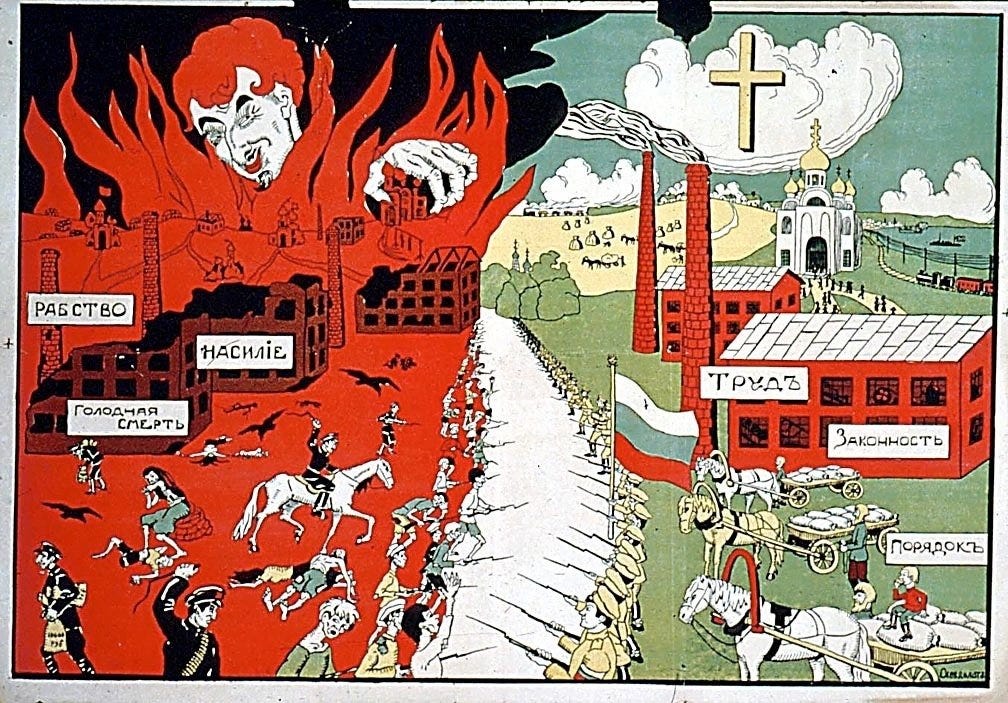
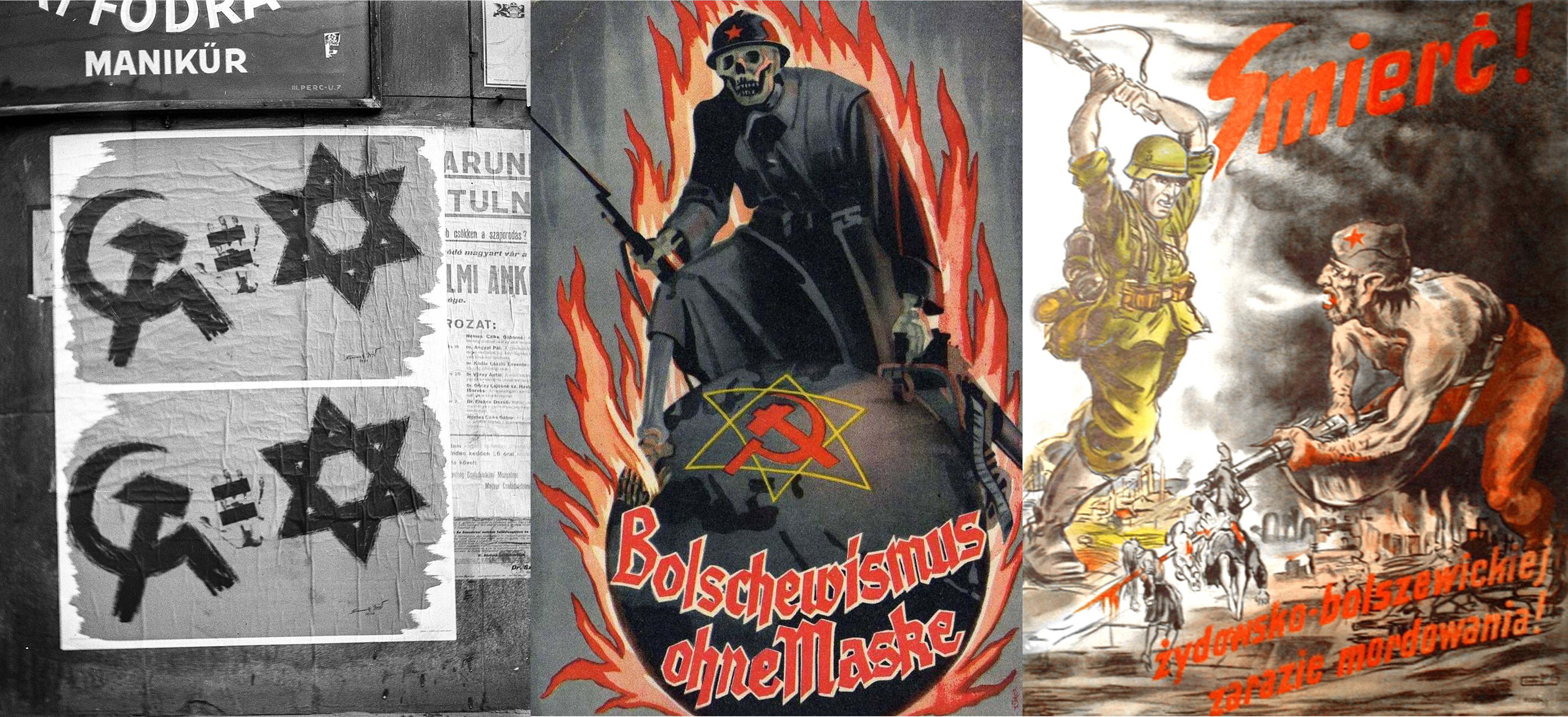
Nazi figures like Alfred Rosenberg and Adolf Hitler drew heavily on these ideas. Hitler described Bolshevism in Mein Kampf as “Jewry’s twentieth-century effort to take world dominion unto itself.” In Nazi propaganda, “Jew,” “communist,” “Marxist,” “Bolshevik,” “Soviet,” and even “Slav” became interchangeable terms for an existential enemy. Eliminating communism became a central ideological mission, with Jews as the ultimate scapegoat alongside other groups marked for subjugation or destruction, including Slavs and Soviet citizens. This conflation of Jews with communism spread from Russia not just to Germany, but also to Poland (where it is referred to as Żydokomuna), Hungary, Finland, the UK and the US.
The reality of Nazi priorities is captured in the famous postwar poem by Protestant pastor Martin Niemöller, First They Came… in which he recalls: “First they came for the Communists, and I did not speak out…” This poem reflects the fact that communists, socialists, and trade unionists were among the very first groups targeted for arrest and imprisonment after Hitler came to power in 1933, even before the regime’s full-scale assault on German Jews. For the Nazis, Jews, communists, and Soviet peoples were part of the same existential enemy—politically, racially, and ideologically—and eliminating them was framed as the necessary precondition for Germany’s survival and expansion. This fusion of antisemitism and anti-communism shaped the Holocaust and the war of extermination in the East, where ideological enemies and racial “undesirables” were murdered side by side.
In 1934, American sociology professor at Columbia University Theodore Fred Abel collected the largest single archive of first person accounts from people who joined the Nazi Party. 581 essays were written by Nazi militants for a competition advertised in a Nazi party journal on “Why I Became a Nazi.” This study provides a window into what the Nazis beliefs and what their priorities were. From the study, the following was summarized by Michael Mann in his book Fascists.
In terms of their core ideological drive:
32% of the essays’ central ideological theme was a transcendent Volksgemeinschaft (People’s or National Community)
23% expressed “super patriotism” (pride in Germany plus hatred of foreigners)
18% identified with Hitler as the embodiment of the Volk (cognate with the English word “folk”)
14% centered on antisemitism
6% centered on “blood-and-soil romanticism”
5% advocated military recovery of lost territories
In terms of their perceived primary enemy:
63% said Marxists / communists / socialists
18% said Jews
8% said liberals / capitalists
5% said Catholics
In terms of antisemitism and hatred of foreigners:
~33% of the essays showed no evidence of antisemitism
~50% revealed some antisemitism
13% showed obsession with antisemitism
22% showed hatred for foreigners abroad
15% showed hatred for “foreigners” in Germany
5% referred to a conspiracy between foreigners abroad and in Germany
In terms of what their specific hatred of the Weimar Republic was:
38% said because it was Marxist or “red”
23% said because it was “liberal or capitalist” and “Marxist”
9% said because it was Marxist
6% said because it was “black” and “red”
30% said because it was run by Jews or other “un-Germans”
19% said because it was a multi-party system
3% said because it was liberal capitalist
The statistical evidence from these rank-and-file reveals a clear hierarchy of hatred that challenges simplified narratives. Their primary focus was unequivocally the elimination of the political left; most identified Marxists, communists, and socialists as their main enemy. Fewer than a fifth primarily named Jews, and about a third showed no evidence of antisemitism at all. Within this worldview, antisemitism functioned not as the core driver but as a powerful and useful secondary scapegoat used to explain national failure and unify supporters. While it was virulent and later catastrophic, the movement’s primary enemy was communism with Jews serving as a convenient ideological vessel for channeling nationalist fervor and consolidating power against a more immediate political foe.
Despite this broader context, scholars for decades have been attempting to paint the Nazi extermination of Jews as unique, with debates happening till this day. Western institutions like the U.S. Holocaust Memorial Museum, the nation’s official memorial to the Holocaust, reinforces this supposed uniqueness. The museum calls it a “watershed event that must always be remembered,” while its founding chairman declared it “a unique crime in the annals of history” that “challenge Western civilization and modern, scientific culture.” The term “genocide” itself was coined by Raphael Lemkin, who also established the Genocide Convention, only because of the Holocaust. This exceptionalist narrative persists despite clear historical continuities with prior genocides.
Unprecedented reparations for the Holocaust
Many will point to the historical persecution of European Jews and the Holocaust as examples of how Jews face systemic oppression today. However, not only are these events in the past, but Jews have been well-compensated for these past atrocities having received unprecedented reparations paid by insurance companies and the governments of Germany, Austria, France, and many others with payments that continue to this day. This also includes countries that were ostensibly not on the side of the Nazis such as the UK. These payments are largely coordinated through the U.S.-based Conference on Jewish Material Claims Against Germany aka the Claims Conference. Critics such as Norman Finkelstein have accused the leaders of Jewish organizations of exaggerating the size of the assets. Some reparations also led to a massive scam where $57 million were fraudulently given to thousands of people who were not eligible for the funds. The following is a list of some of the major reparations given to Jewish Holocaust survivors:
Germany has paid more than €80 billion (~85-95 billion USD) since 1952 both to Israel and the Claims Conference for Holocaust survivors and their heirs by 2021 with annual payments guaranteed through to 2027 at least. These include direct compensation payments (pensions, hardship funds), home care services, holocaust education and community programs.
Switzerland’s two major commercial banks agreed to pay $1.25 billion to survivors as restitution for lost assets.
Austria created two funds totaling to $510 million funded by the government and private sector: $360 million goes to a settlement fund for Holocaust related lawsuits, and $150 million goes directly to Holocaust survivors.
Several major European insurance companies agreed with the World Jewish Congress to settle claims on policies taken out by Holocaust victims, including in France, Germany, Switzerland and Italy. The funds were well into the hundreds of millions of dollars. Italian insurance company, Generali, agreed to pay $100 million.
France agreed to pay $60 million to survivors and their heirs worldwide
Hungary agreed to distribute around $21 million to survivors. They also increased welfare pensions for survivors by 50% in 2017.
Slovakia created a special fund for holocaust victims with $18.5 million put forward, including funds for cultural, social, and educational community programs, as well as renovations to synagogues.
Czech Republic allocated 300 million Czech Korunas (~10 million USD) to alleviate property injustices incurred by victims of the holocaust.
Serbia provides an annual payment of €950,000 (~1.12 million USD) to Jewish communities since 2016 until 2041.
Negotiations facilitated by the World Jewish Restitution Organization (WJRO) further restored property to Jews across countries including Bulgaria, Luxembourg, Poland, Lithuania, Romania, Moldova, North Macedonia, and Estonia.
Contrast this with the lack of reparations for slavery and colonialism inflicted on Africans and indigenous populations wiped out by Europeans. Aside from some extremely local examples, Africans and their descendants in the diaspora have not received major reparations for slavery.
In fact, in many cases the opposite has happened. Haiti was forced to pay France for almost a century and a half after they gained independence and abolished slavery as “compensation to French plantation owners.” The amount paid far exceeded the actual losses. According to economists, had that money been retained by Haiti and invested domestically, it would have added more than $21 billion to the country’s economy over time. This is of course not to mention the endless political interference and military occupation the U.S. and France have engaged with in Haiti almost uninterrupted till today, including the overthrowing of governments and hand-picking of puppets. African nations today face Neo-colonial exploitation through Western-backed wars, crippling IMF debt traps, and economic warfare through sanctions.
If we compare this again to Native Americans, victims of one of the deadliest genocides in human history, with an estimated death toll of 50–60 million people across the Americas and population losses of 80–90%, the scale of reparations is almost nonexistent. The U.S. never provided comprehensive compensation for centuries of killings, land theft, and forced removals, offering instead small, fragmented settlements after long legal battles. Even these payments were framed as legal resolutions, not acknowledgments of genocide. Between post–World War II and 1978, the U.S. paid about $1.3 billion to tribes through compensation programs, less than $1,000 per tribal member. In 1980, the Supreme Court ordered the U.S. to pay the Sioux nation approximately $105 million for illegal land seizures, again, a mere fraction of what was wrongfully taken.
While Holocaust reparations have been vast, coordinated, and internationally enforced with tens of billions of dollars to survivors and their heirs, Native American reparations have been piecemeal, begrudging, and minuscule relative to the scale of harm, with most stolen land never returned and many reservations still facing poverty rates above 40%.
Liberia, often seen as a parallel to Israel for an oppressed group, was established in the early 19th century as a private settler-colonial project in West Africa by the American Colonization Society (ACS) with U.S. congressional support as a homeland for freed African Americans. Like Israel, it was created with Western backing, but the scale and consistency of aid could not be more different. Settlers faced mortality rates as high as 40% from tropical diseases, well known to the ACS, which nonetheless kept sending people. Although Liberia declared independence in 1847, the U.S. withheld recognition until 1862.
Economic exploitation followed, most notoriously through the 1926 Firestone concession, which saddled the country with crippling debt, put U.S.-appointed financial advisers in charge of its budget, and consumed nearly all government revenue by the early 1930s. Firestone’s rubber operations were linked to severe abuses, including forced child labor and dangerous quotas for workers as young as five. Liberia’s vulnerability was compounded by U.S. political meddling and public health disasters such as the 2014–16 Ebola epidemic, which killed nearly 5,000 people and collapsed an already fragile health system. In stark contrast to Israel’s $150 billion in U.S. aid, over $15,000 per citizen, Liberia has received only about $6 billion total, or roughly $1,000 per person, a per-capita disparity of at least 14-to-1 that left it underfunded, politically marginal, and economically dependent while Israel was entrenched through sustained Western investment.
Post-WWII Nazi targets were not Jews
Western society would make you believe the sole focus of Nazis was to target Jews. After WWII, the U.S. and largely the colonial West absorbed and recruited the Nazis to help them with espionage operations, wars, massacres and propping up brutal dictatorships across the globe. These fascists were primarily recruited to crush leftists, anti-colonial liberation movements, and uphold the Neo-colonial order. Many of these Nazis and fascists were repurposed as forces against subjugating the global working class and oppressed nations.
The U.S. helped set up the Gehlen Organization in 1946, an intelligence agency in post-war occupied West Germany which employed hundreds of former members of the Nazi Party. It was headed by Nazi military and intelligence officer, Reinhard Gehlen aka “Hitler’s Super Spy” and was defended by the CIA. The agency was the precursor to the Bundesnachrichtendienst (BND or Federal Intelligence Service), the modern-day German equivalent of the CIA.
Ex-Nazi officer Klaus Barbie, backed by and under the protection of U.S. intelligence, trained the military dictatorships in Bolivia and Peru, playing a key role in identifying, torturing and executing leftists through disappearances and death squads during the 1970s and 1980s under Operation Condor. NATO and the CIA in collaboration with several European intelligence agencies organized Operation Gladio, clandestine “stay-behind” operations to crush left-wing movements and unions. This was done through supporting former Nazi SS officers, fascist militias and terrorists who used assassinations, psychological warfare, and false flag operations in Italy, Turkey, Greece, France, and many others. The CIA also ran Operation Bloodstone where former Nazis were recruited to work undercover in the Soviet Union, Latin America, Canada and even domestically within the U.S.
In Algeria, about 20,000 Wehrmacht and Waffen SS veterans joined the French Foreign Legion to fight “the war of the white race,” including Rolf Steiner who also fought alongside Western-backed regimes in Vietnam, Nigeria and Sudan. Notorious Nazi-turned-mercenary Siegfried Müller who emigrated to Apartheid South Africa was employed by the military of Congo, then called Congo-Léopoldville, to crush the Simba rebellion, committing widespread atrocities and war crimes.
Even Mossad, the intelligence agency of the so-called ‘Jewish State’, had recruited SS officers into their ranks to spy on Arab states such as Otto Skorzeny and Hermann Valentin in Egypt, and Walter Rauff in Syria. In fact, Zionists and Nazis have had a long-standing close relationship, as documented by Lenni Brenner in his 2002 book, 51 Documents: Zionist Collaboration with the Nazis.
The Holocaust Industry
There is an entire industry dedicated to exploiting the memory of the Holocaust for monetary and political gain that spans publishing houses pushing out a steady stream of books, the constant production of big-budget films and TV series, high-profile documentaries on streaming platforms, and an ever-expanding network of museums and memorials.
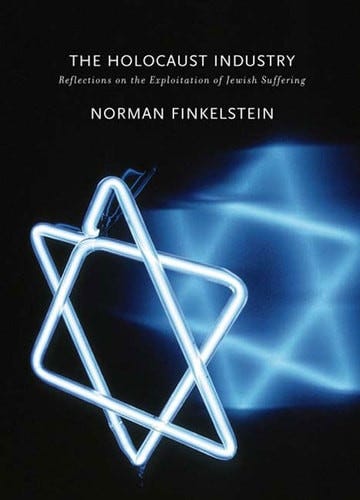
Major Hollywood studios have turned Holocaust narratives into multi-million-dollar box office events. The publishing industry markets Holocaust memoirs and historical fiction as a perennial best-seller category, with some titles selling in the millions. Holocaust museums attract millions of visitors annually and receive substantial public and private funding. The U.S. Holocaust Memorial Museum (USHMM) alone has an operating budget exceeding $150 million a year, funded in part by the federal government and wealthy donors. The global “Holocaust remembrance” NGO sector, including the World Jewish Congress, the Claims Conference, and Yad Vashem, commands hundreds of millions of dollars in combined annual budgets, with well-paid staff and a constant calendar of high-profile fundraising galas. The double standards of the USHMM have been criticized. As Finkelstein put it:
“The first question is why we even have a federally mandated and funded Holocaust museum in the nation’s capital. Its presence on the Washington mall is particularly incongruous in the absence of a museum commemorating crimes in the course of American history. Imagine the accusations of hypocrisy here were Germany to build a national museum in Berlin to commemorate not the Nazi genocide, but American slavery or the extermination of the Native Americans.”
— Norman Finkelstein, The Holocaust industry: Reflections on the exploitation of Jewish suffering (2000)
Even a country as remote as Australia, with a total population of only 27 million, has at least eight museums dedicated to the Holocaust, with more planned to be built so that every single state and territory will eventually have one. In contrast, there is no museum dedicated to the genocide of Indigenous Australians whose population was reduced from an estimated 1-1.5 million before invasion to fewer than 100,000 by the early 1900s; only scattered exhibits within larger museums.
According to Wikipedia’s List of Holocaust memorials and museums, there are at least 267 sites in more than 50 countries, spanning all continents around the world except Antarctica. These include not only former Axis and Allied countries, but also nations with no involvement in the Holocaust whatsoever, such as Albania, New Zealand, Brazil, Mexico, Chile, Ecuador, Guatemala, Uruguay, Indonesia, the Philippines, South Africa, and Suriname.
The effects of this industry are highly successful in shaping global awareness. A 2014 poll by the ADL, surveying over 100 countries, found that despite 74% of respondents saying they had never even met a Jewish person, a majority (54%) had heard of the Holocaust. The Holocaust memory industry ensures that this single genocide occupies a unique, almost sacred place in the Western moral imagination. It generates not only cultural capital but financial and political capital, reinforcing a narrative in which the Holocaust stands apart from all other atrocities. This exceptionalism is then leveraged to justify the state of Israel’s claim to moral necessity and immunity from criticism.
Insightful. Been diving into so much historical literatur lately and you really make me question accepted narratives.